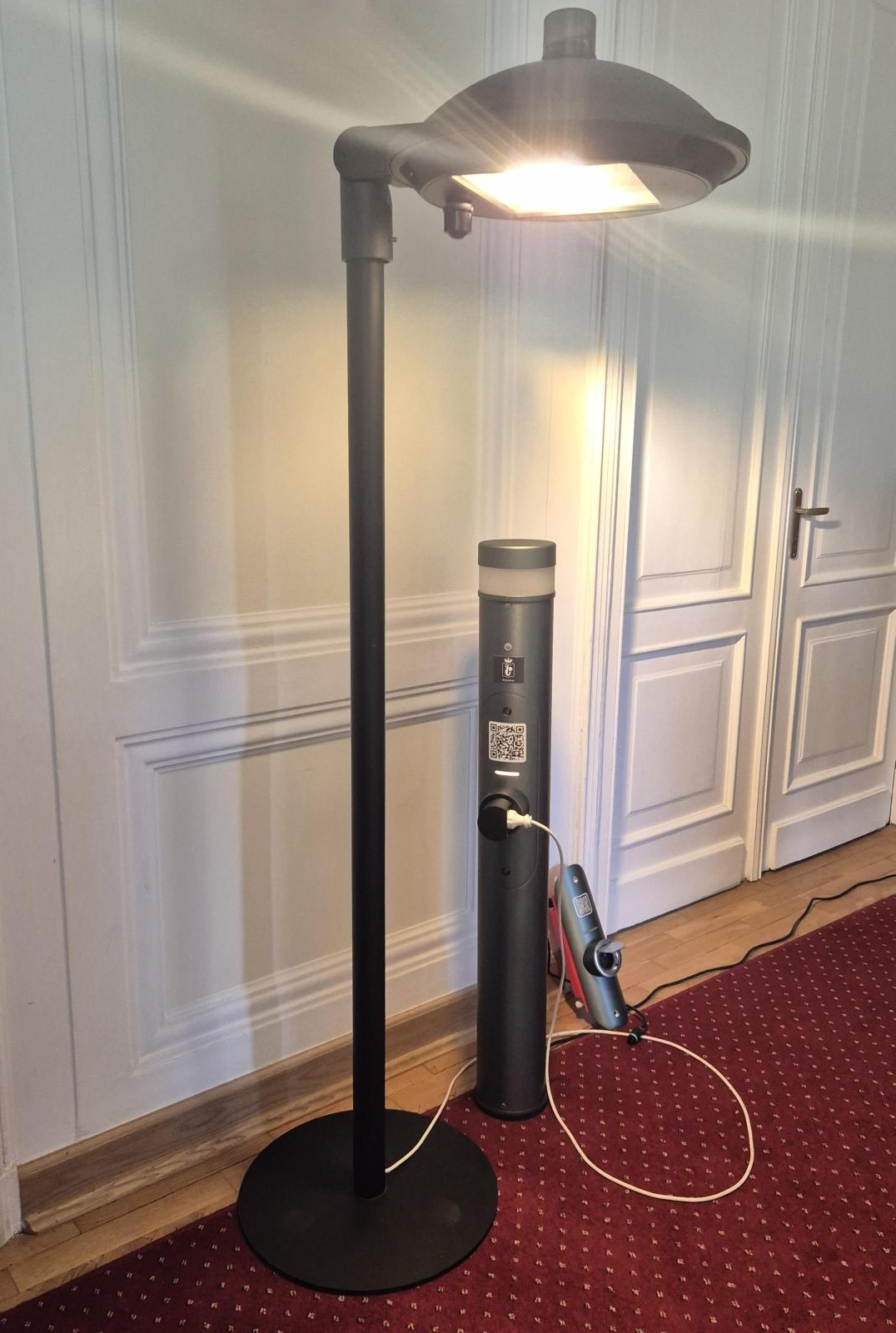

Warsaw’s Municipal Roads Authority (ZDM) has selected Emitel’s bid as the most advantageous in a tender to build and deploy an advanced intelligent lighting control system for the Polish capital. The smart city solutions will enable Warsaw to reduce electricity consumption and make more efficient use of its existing infrastructure. Municipal services will be able to respond to faults more quickly and carry out maintenance work more effectively. The value of the core project is close to PLN 79 million.
Warsaw’s tender for an intelligent street lighting control system is a strategic investment designed to modernise over 110,000 luminaires, representing a substantial proportion of the city’s lighting infrastructure. The new system will enable remote lighting management, early fault detection and dynamic adjustment of light intensity. The agreement covers the development and maintenance of IT systems, a cloud-based infrastructure management platform, the supply of lighting controllers and the equipping of a dedicated management centre. The contract has been signed for eight years, with an option to extend it for a further five.
“Delivering a project of this scale and sophistication for the people of Warsaw is a significant undertaking. Intelligent lighting will not only improve safety and quality of life in the city, but will also support more responsible management of both the environment and public finances. Emitel is steadily expanding its offering to support the transformation of Polish cities into smart, connected metropolitan areas. Drawing on our extensive experience in delivering complex IoT projects, we are a proven partner for projects of any scale, combining telecommunications and IT technologies and providing end-to-end services from design through to system maintenance. We do this in a modern, reliable and secure way,” said Maciej Pilipczuk, President of the Management Board of Emitel.
Over the next two years, intelligent controllers enabling remote monitoring and management of lighting will be progressively installed on street lights across the capital. Emitel will supply the devices, while installation will be carried out by a contractor appointed by the City of Warsaw under a separate tender. As part of the project, Emitel will also build the system and a modern Lighting Management Centre. Equipped with operator workstations and a video wall, the centre will provide real-time management and visibility of the city’s lighting infrastructure.
“Over the course of five years, we have replaced all lighting fixtures in Warsaw. As a result, we are now saving approximately 60 million PLN annually. We invested 65 million PLN in the replacement of these fixtures, and the savings achieved have already reached nearly 150 million PLN. Importantly, we are constantly reinvesting these funds into further modernizations. The recently signed contract for a lighting control system will allow for an additional 30% in savings. This solution will also enhance the city’s resilience to climate change challenges and potential energy supply disruptions. Ultimately, Warsaw’s street lighting will be able to operate using only about 20% of the electricity required just a few years ago. And we will continue to allocate the saved funds to further investments.” said Łukasz Puchalski, Director of the Municipal Roads Authority of the Capital City of Warsaw
Benefits of the system
The control system will give Warsaw significantly greater oversight of its road lighting. The controllers will allow ZDM to continuously monitor luminaire parameters, enabling a much faster response to faults. Notifications will be sent automatically and immediately to maintenance teams, allowing them to intervene without delay. Problems will also be diagnosable without opening a luminaire and, in some cases, without an on-site visit. This will generate further savings through lower street lighting maintenance costs while improving safety, as faster intervention means faulty luminaires can be restored to proper operation sooner.
Using the controllers, the Lighting Management Centre will not only be able to monitor changes in luminaire performance in real time but also make adjustments remotely. At present, lighting is switched on and off by independent controllers installed in more than 2,200 lighting cabinets across the city. Switching times are programmed according to sunset and sunrise and cannot be altered remotely. Once the new system is operational, settings will be adjustable even on a daily basis, for example in response to weather conditions. On a bright day, lighting may be switched on a few minutes later, while during heavy cloud cover it may be activated a few minutes earlier. This will ensure that street lighting is used precisely when residents need it.
The system will also make it possible to optimise the output of each individual luminaire. On streets with highly reflective surfaces, such as light-coloured roadways, lamps will be able to operate at lower power. The City will also be able to reduce lighting levels on local streets where traffic is very light at certain times of night, particularly during the winter months. Introducing appropriate lighting profiles may further reduce electricity consumption and limit light pollution during night-time hours. Based on the adopted estimation model, annual energy savings could reach up to 30%.
Emitel is steadily expanding its offering to support the transformation of Polish cities into smart, connected metropolitan areas. Drawing on extensive experience in delivering complex IoT projects, Emitel is a proven partner for projects of any scale, integrating telecommunications and IT technologies and providing comprehensive services from design through to system maintenance.
Wrocław is among the cities already using solutions delivered by the company. It has delivered one of Poland’s largest IoT projects, installing a remote meter-reading system for the Municipal Water and Sewerage Company covering 70,000 water meters. Other solutions used by local authorities to improve residents’ quality of life include parking-space availability monitoring, noise-level sensors and water-level monitoring in drainage channels, as implemented in Piaseczno.